Proof of Work vs Proof of Stake: How Blockchains Reach Consensus
Proof of work and proof of stake both make cheating a blockchain expensive. Compare miners vs validators, energy vs collateral, and what it means for you.
On this page
The short answer
Proof of work and proof of stake are two ways a blockchain agrees on which transactions are real. Proof of work makes cheating expensive with electricity and hardware; proof of stake makes it expensive with locked-up coins that can be confiscated. Bitcoin uses the first, Ethereum the second. Both aim for the same thing: honest records without a referee.
Why do blockchains need consensus at all?
A blockchain has no bank in the middle deciding whose transaction counts. Thousands of independent computers each keep a copy of the ledger, and they all need to agree on the same version of history. The process for reaching that agreement is called a consensus mechanism.
The problem it solves is double-spending. Digital money is just data, and data can be copied. Without some referee, you could send the same coin to two people at once and let each believe they got paid. A bank prevents this by keeping the one official ledger. A blockchain has to prevent it with no bank at all.
So the network runs a kind of ongoing election. Someone gets picked to write the next page of the ledger, everyone else checks their work, and the rules make lying more expensive than telling the truth. How you make lying expensive is the entire difference between proof of work and proof of stake. If the ledger idea itself is still fuzzy, start with how blockchain works and come back.
How proof of work works
Proof of work, Bitcoin's model, picks the next ledger-writer through a race. Computers called miners compete to solve a math puzzle: take the pending transactions, add a random number, and run it all through a hash function until the output starts with enough zeros. There's no shortcut, just brute guessing at absurd scale. As of mid-2026, the whole network runs at roughly 800 to 900 exahashes per second — hundreds of quintillions of guesses every second.
The first miner to find a valid answer broadcasts it, everyone verifies it in a split second, and that miner earns newly created bitcoin plus the transaction fees in the block. On Bitcoin, a winner emerges roughly every 10 minutes, and the puzzle difficulty automatically adjusts to keep that pace.
Why burn all that electricity on guessing games? Because the energy is the security. Rewriting past transactions would mean redoing all that work faster than the rest of the network combined, which in practice means out-spending every honest miner on hardware and power at once. The cost of cheating is a literal utility bill, and it's enormous.
- Who writes blocks: miners, chosen by winning a computational race
- What cheating costs: the electricity and hardware to outpace the whole network
- Who earns rewards: whoever owns the mining hardware that wins
Plain-English version: proof of work is a lottery where tickets cost electricity. Buying enough tickets to rig the draw would cost more than you'd steal. That's the whole security model.
How proof of stake works
Proof of stake replaces the energy race with a financial deposit. Instead of miners, the network has validators: participants who lock up coins as collateral for the right to propose and confirm blocks. On Ethereum, which switched from proof of work to proof of stake in the September 2022 upgrade known as the Merge, that deposit is 32 ETH per validator.
The network then picks validators, weighted by stake, to write the next block. Others attest that the block follows the rules, and honest work earns rewards paid from new issuance and transaction fees. No puzzle, no guessing race, so the energy use is a tiny fraction of proof of work's. Ethereum's own post-Merge estimate put the 2022 reduction at over 99.9%. And the model has real scale behind it: as of July 2026, about 40 million ETH, roughly 32% of the entire supply, sits staked, per ethereum.org.
The teeth come from slashing. A validator caught signing conflicting blocks or trying to rewrite history has part of its staked coins destroyed by the protocol and gets ejected. Cheating doesn't burn electricity here; it burns your own deposit.
- Who writes blocks: validators, selected in proportion to their stake
- What cheating costs: your locked coins, slashed automatically by the protocol
- Who earns rewards: whoever stakes coins, directly or through a pool
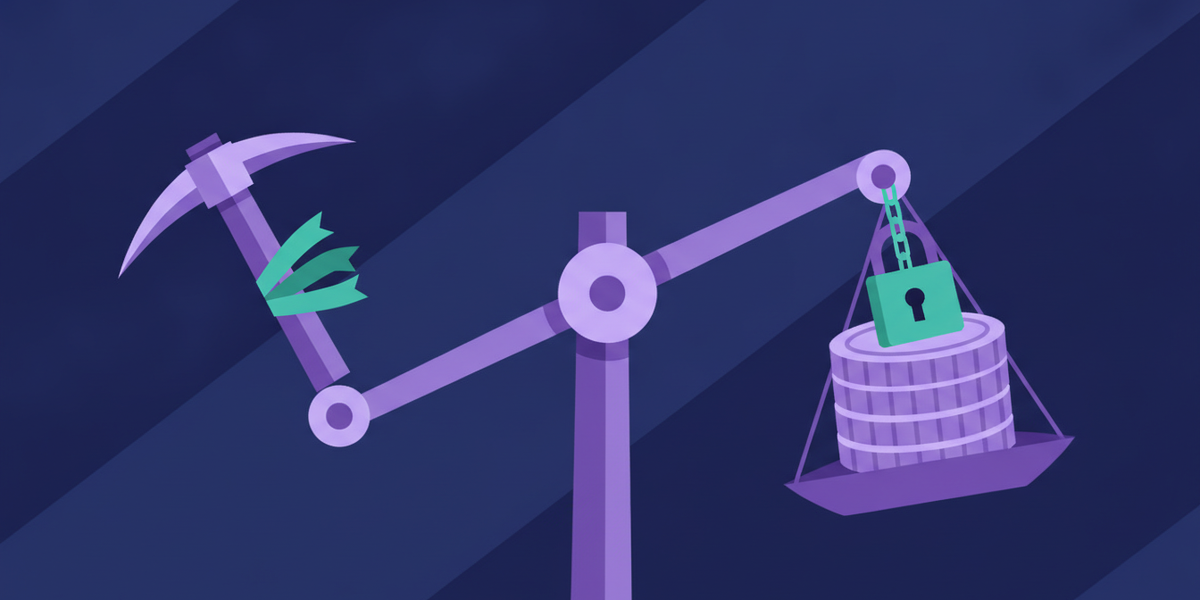
Proof of work vs proof of stake, side by side
Neither system is simply "better." They make different trade-offs, and reasonable people argue about which set of assumptions is safer. The honest comparison looks like this:
| Proof of work | Proof of stake |
|---|---|---|
Security assumption | No attacker can out-spend honest miners on energy and hardware | No attacker can acquire and risk a majority of the staked coins |
Cost of attack | External: buy power and machines | Internal: buy the coin itself, then lose it to slashing if caught |
Energy use | Consumes power on an industrial scale by design | Runs on ordinary servers |
Hardware | Rewards specialized mining rigs and cheap electricity | Needs a modest computer and a stake |
Who earns rewards | Hardware operators | Coin holders who stake, which is easier for ordinary users to join through pools |
Track record | Has secured Bitcoin since 2009 | Younger at massive scale, with Ethereum's version live since 2022 |
The "51% attack" you'll hear about is just this cost made concrete. Control most of the network's mining power or stake and you could, briefly, rewrite recent history. On proof of work, that means buying and running more machines than every honest miner combined, an industrial project with a permanent power bill. On proof of stake, it means buying up a majority of the staked coins, which drives the price against you as you buy, and the protocol slashes your stake if you're caught. Either way, the attack tends to destroy the value of the thing you'd be stealing. That self-defeating math, more than any single rule, is what keeps both systems honest.
Bitcoiners tend to value proof of work's physical, battle-tested cost. Proof of stake supporters point to efficiency and lower barriers to participating. The bitcoin vs ethereum split is partly this exact philosophical divide.
What does this change for you day to day?
Honestly, almost nothing. When you send bitcoin or ether, the wallet steps are identical: paste an address, confirm, wait for the network to include your transaction. You'll never solve a puzzle or slash anyone. Consensus runs invisibly underneath, the way you don't think about card-network plumbing when you tap to pay. In our experience, this is the part beginners overthink: consensus is well worth understanding, but it almost never changes which button you press.
The differences people notice, fees and speed, mostly come from other layers anyway. Fees rise when a network is busy, whatever the consensus type. Confirmation habits differ between chains for reasons beyond PoW vs PoS, like block times and finality rules. So don't pick a coin for payments based on consensus alone; the practical stuff is covered in our cryptocurrency basics guide.
Where it does touch you: if you hold a proof-of-stake coin, staking it is an option, with its own fine print. Which brings us to the big misconception.
Worth knowing: exchanges and wallets often offer one-click staking. Convenient, but you're usually delegating to their validators, and rewards arrive minus their cut. Read what's actually being done with your coins before clicking.
Is staking yield free money?
No, and this is the misconception worth killing. Staking rewards feel like interest from nowhere, a money printer for anyone holding the coin. What's really happening: rewards come from new coin issuance plus a share of transaction fees, paid out for doing the network's security work. The headline number is modest anyway; ethereum.org listed the base staking rate at about 2.6% as of July 2026. In our experience, the yield percentage is the first thing beginners notice and the risk fine print is the last thing they read, when it should be the other way around.
Issuance matters more than it sounds. If the network mints new coins to pay stakers, everyone's existing coins are diluted a little. Stakers earn the new supply; non-stakers quietly fund part of it. Your "yield" is partly a transfer, not created wealth. Fee revenue is real income, but it depends on people actually using the network.
And staking carries real risks: the coin's price can fall far more than the yield pays, some setups lock funds for a period, validators can be slashed for downtime or misbehavior, and third-party staking services add counterparty risk. A percentage number on a screen isn't a savings account. Treat any staking decision as a risk decision, not free money.
Play it smart: consensus mechanisms decide how a blockchain stays honest, not whether a coin will hold its value. Never stake or spend more than you can afford to lose. This article is education, not financial advice. 18+/21+ depending on your jurisdiction.
Sources
- Blockchain.com — Total Hash Rate chart — retrieved July 2026
- Bitcoin.org — How Bitcoin Works — retrieved July 2026
- Ethereum.org — The Merge — retrieved July 2026
- Ethereum.org — Staking — retrieved July 2026
- Ethereum.org — Ethereum Energy Consumption — retrieved July 2026
Frequently asked questions
Is proof of stake as secure as proof of work?
Neither is simply better; they make different trade-offs. Proof of work assumes no attacker can out-spend honest miners on energy and hardware, and it has secured Bitcoin since 2009. Proof of stake assumes no attacker can acquire and risk a majority of the staked coins, and at massive scale it is younger, live on Ethereum since 2022. Reasonable people disagree about which set of assumptions is safer.
What is a 51% attack and why is it so hard to pull off?
A 51% attack means controlling most of a network's mining power or stake, which would let an attacker briefly rewrite recent history. On proof of work that requires buying and running more machines than every honest miner combined; on proof of stake it means buying a majority of the staked coins, which drives the price against you and risks slashing. Either way, the attack tends to destroy the value of what you would steal.
Does it matter for everyday transactions whether a coin uses proof of work or proof of stake?
Almost not at all. Sending bitcoin or ether involves the same wallet steps: paste an address, confirm, and wait for the network to include the transaction. Consensus runs invisibly underneath. Fee and speed differences mostly come from other layers — fees rise when a network is busy regardless of consensus type, and confirmation habits depend on block times and finality rules rather than PoW versus PoS.
What happens if a validator cheats on a proof-of-stake network?
The protocol punishes cheating through slashing. A validator caught signing conflicting blocks or trying to rewrite history has part of its staked coins automatically destroyed and gets ejected from the network. On Ethereum, each validator locks up 32 ETH as collateral, so cheating burns the validator's own deposit rather than electricity — that financial penalty is what keeps proof-of-stake networks honest.
Where do staking rewards actually come from?
Staking rewards are paid from new coin issuance plus a share of transaction fees, in exchange for doing the network's security work. New issuance slightly dilutes everyone's existing coins, so part of the yield is a transfer from non-stakers rather than created wealth. Fee revenue is real income but depends on network usage. Staking also carries risks: price drops, lockup periods, slashing, and counterparty risk with third-party services.
How much less energy does proof of stake use than proof of work?
Ethereum's own estimate after its September 2022 switch to proof of stake, known as the Merge, put the energy reduction at over 99.9%. Proof of work consumes power on an industrial scale by design, because the energy itself is the security. Proof of stake replaces that race with locked-up coins as collateral and runs on ordinary servers with a modest computer.
Go deeper with a course
About the author
Provably Fair & Payments Writer
Devon covers the technical side of crypto: how blockchains reach consensus, provably fair verification, seeds and hashes, and how deposits and withdrawals actually move — from casino approval to network confirmations.